Page 1 of 1

Steam locomotive boiler explosions

Posted: Thu May 28, 2009 9:37 am
by luke

Re: Steam locomotive boiler explosions

Posted: Thu May 28, 2009 8:46 pm
by gedunk
The MKT staged accident was quite a show for it's day. Lots of people were there because of all the advertising about the staged accident.

In the first picture, the locomotives have touched cowcatchers, are are backing away from each other. You can see workers on top of the boxcars. Each train backed up almost a mile, the engineers tied down the whistles, opened the throttles, and jumped.

The photographer lost an eye to a flying bolt from the explosion at the moment he snapped the collision picture. Several other onlookers were injured as well from all the shrapnel flying.

Re: Steam locomotive boiler explosions

Posted: Fri May 29, 2009 8:37 am
by luke
gedunk wrote:The MKT staged accident was quite a show for it's day. Lots of people were there because of all the advertising about the staged accident.
Yep. From 1890 to about 1910, staged cornfield meets were very popular attractions.

One man, nicknamed "Head-On Joe," staged 73 meets, wrecking 146 retired 4-4-0s.
On several occasions, he added a wooden coach which was doused in flammable liquid, and put a bucket of charcoal in it, so that the coach would catch fire in the collision.

The crowds loved it.


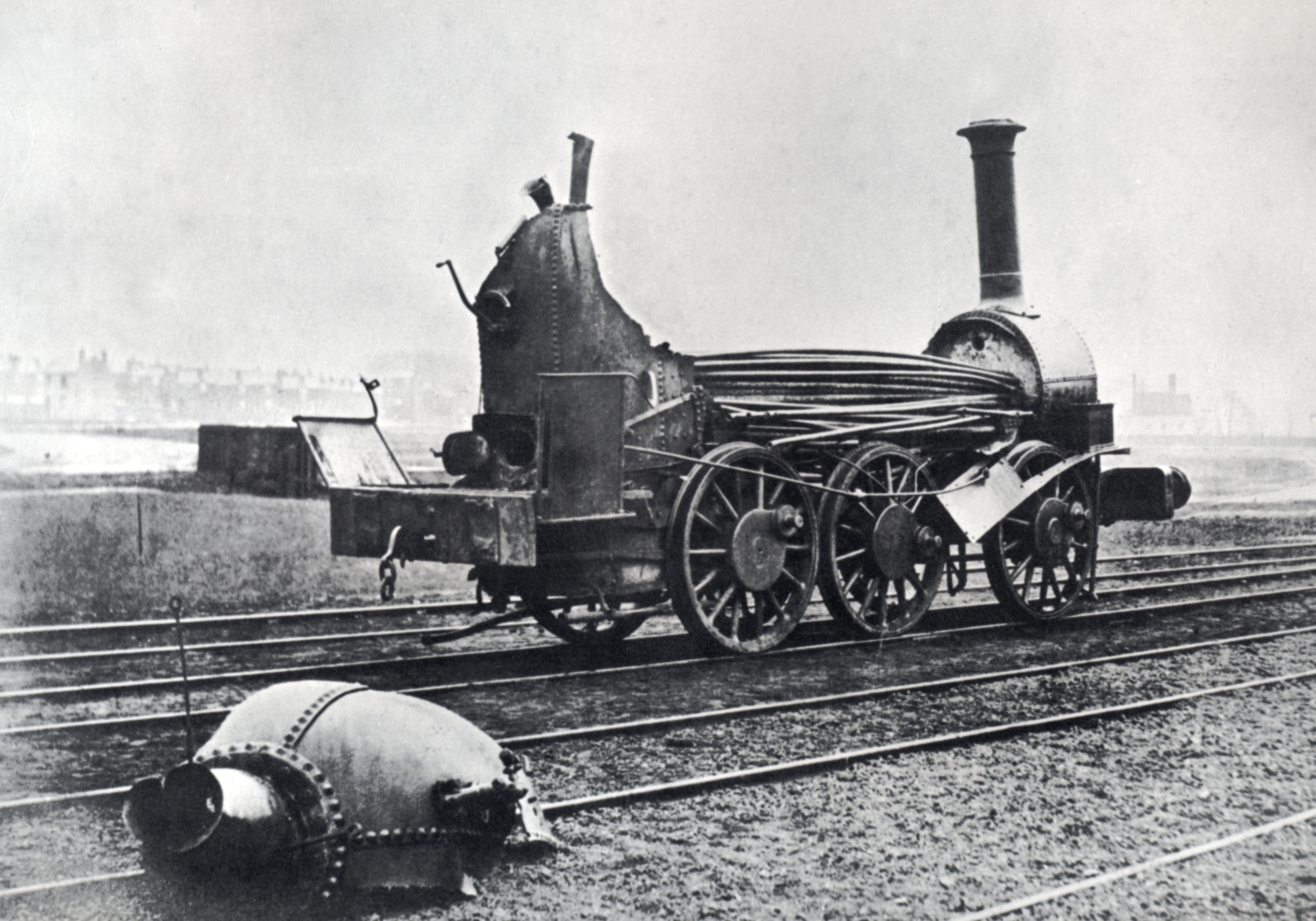
Speaking of MKT, they had a real boiler explosion occur at Cumby, Texas in 1921.

The explosion blew the 2-6-0's smokebox door, boiler, & cab completely away, but the running gear & train remained on the rails, and coasted on for 55 feet past the point of the explosion!

Another explosion occurred on Dec. 19. 1890.

On that day, the New York, New Haven, & Hartford's #69 exploded as it was passing through Wallingford, CT.
The locomotive was chopped in two crosswise, and the traction sandbox shot at least 100 ft in the air, before coming down through the roof of a house ahead & to the right of the locomotive.

Thankfully, no one was hurt in the house, and amazingly, the crew survived the violent explosion. :Noway:

Re: Steam locomotive boiler explosions

Posted: Sat May 30, 2009 8:11 pm
by gedunk
The working pressures in steam lcomotives were pretty impressive. Even an older, modest sized engine was under pretty heavy strain if you do the math.

Say an older 4-4-0, even an early 2-6-0 had a crown sheet over the firebox about 3 X 6 feet, or 18 square feet total. Multiplying that 18 by 144 (the number of square inches in a square foot) gives you 2592 total square inches. Multiplying 2592 times the 180 psi working pressure eventually works out to 223.28 tons of pressure on that crown sheet.

Let the water in the boiler get a bit low, the crown sheet overheats, gets soft, and ker-boom.
Most boiler explosions were of this kind.

Re: Steam locomotive boiler explosions

Posted: Sun May 31, 2009 5:32 pm
by Crossingman18
gedunk wrote:The working pressures in steam lcomotives were pretty impressive. Even an older, modest sized engine was under pretty heavy strain if you do the math.

Say an older 4-4-0, even an early 2-6-0 had a crown sheet over the firebox about 3 X 6 feet, or 18 square feet total. Multiplying that 18 by 144 (the number of square inches in a square foot) gives you 2592 total square inches. Multiplying 2592 times the 180 psi working pressure eventually works out to 223.28 tons of pressure on that crown sheet.

Let the water in the boiler get a bit low, the crown sheet overheats, gets soft, and ker-boom.
Most boiler explosions were of this kind.
My head hurts

Re: Steam locomotive boiler explosions

Posted: Sun May 31, 2009 6:23 pm
by luke
gedunk wrote: Let the water in the boiler get a bit low, the crown sheet overheats, gets soft, and ker-boom.
Most boiler explosions were of this kind.
Yep, crown sheet failures could do anything from flipping the locomotive on its side, to separating the boiler & firebox, and sometimes the cab & smokebox from the running gear.

An example of the last was the New York Central's 3361, which exploded at Bergen, NY, on 7/27/1928.

The cab, firebox, boiler, and smokebox were blasted clean away, leaving just the pistons, bogies, & base frame!

The sudden stop resulted in the crushing of the coaches' vestibules.

Also, in my opinion, the modern day equivalent of a boiler explosion is the blown-out prime mover.