Different ways to mark a crossing out of service
Posted: Thu Jan 19, 2023 5:57 pm
One thing that I've noticed from personal observation and from others' photos, there doesn't seem to be any standard way to sign/otherwise indicate the situation to crossing users when a rail line goes dormant or is abandoned, but the tracks are left in place for years or even decades. Each state/municipal jurisdiction and/or railroad company seems to have a different way of doing it.
One of the most bizarre I've seen was posted in the recent update by freebrickproductions, in Preston, Georgia.
Some other ways I've seen are:
1.) Remove the signals, but leave the (may or may not be paved over) tracks.
2.) Leave the tracks everywhere else, but remove the rails from the crossings, pave over the grade, and remove the signals.
3.) Leave the signals, but turn and/or bag the lights and remove the gates, if present. This was done for example at WIS-28 in Mayville, WI when it and all crossings north of it were physically disconnected from the remaining active portion of that branch line. The mast lights were bagged and the cantilever arms turned 90 degrees to no longer hang over the road. The tracks were also removed from the road and the grade paved over. This was done for the relatively short interval before the signals were removed entirely.
Another example is this crossing in Farmington, IL on an ex-C&NW/UP line, until those tracks and signals were removed. The same thing was also done further east on that same line at Trivoli, IL per a photo on Abandonedrails, and actually all the way east to the junction with another line in Peoria.
4.) Leave the signals, and install "TRACKS OUT OF SERVICE" or (in the past, I don't think they are used anymore) "ABANDONED" signs below (or in some cases, bolted over the top of) the crossbucks.
5.) Do as above but install "EXEMPT" signs instead. This allows buses and other vehicles (such as trucks carrying hazardous materials) that would normally have to stop and look at the crossing, to be "exempt" from doing so. However this is somewhat ambiguous because the rail line being unused or abandoned is not the only reason (at least per Wisconsin law) that a crossing can be "exempted." The crossing being located close to an intersection where the stopping vehicles would create a significant obstruction to the flow of traffic is another. However, it is common for "EXEMPT" crossings to mostly be on lines with light/slow train traffic. I've never seen one on a busy Class I mainline, for example, but I have seen them at at least one crossing that gets about 6-8 train moves per day.
6.) Remove the signals, but in their place install "TRACKS OUT OF SERVICE" signs on new posts/masts. For example, this was done at WIS-57 in Milwaukee and other crossings on the old Milwaukee Road Beer Line. Note this was done when the tracks were removed everywhere BUT at the crossings. In fact, Google Street view shows that the rails still remained in the road here as of last fall, although the signs had disappeared by 2016!
Another example is the two Webster Avenue crossings in Green Bay that were located on the industrial lead to the Proctor & Gamble East River Mill that came off the old Green Bay & Western line, when it was finally disconnected from the main and formally taken out of service after who knows how many years of not being used.
7.) Do nothing at all and let the signals slowly fall apart over the years, due to weather, vehicle impacts, and sticky-fingered metal scrappers/souvenir-hunting "railfans." This was done on UP's ex-C&NW Capitol Drive industrial lead in Milwaukee, at Hampton Avenue and Lydell Avenue. The last train I believe was in 2003. Buses and other vehicles presumably were still required to stop and check down the rusty, weed-choked, obviously unused tracks. The signals were finally removed by September, 2011, and the tracks by 2015 as the Oak Leaf Trail was being built along the ROW.
Have any of you observed any other methods of indicating an out-of-service crossing to road users?
One of the most bizarre I've seen was posted in the recent update by freebrickproductions, in Preston, Georgia.
Some other ways I've seen are:
1.) Remove the signals, but leave the (may or may not be paved over) tracks.
2.) Leave the tracks everywhere else, but remove the rails from the crossings, pave over the grade, and remove the signals.
3.) Leave the signals, but turn and/or bag the lights and remove the gates, if present. This was done for example at WIS-28 in Mayville, WI when it and all crossings north of it were physically disconnected from the remaining active portion of that branch line. The mast lights were bagged and the cantilever arms turned 90 degrees to no longer hang over the road. The tracks were also removed from the road and the grade paved over. This was done for the relatively short interval before the signals were removed entirely.
Another example is this crossing in Farmington, IL on an ex-C&NW/UP line, until those tracks and signals were removed. The same thing was also done further east on that same line at Trivoli, IL per a photo on Abandonedrails, and actually all the way east to the junction with another line in Peoria.
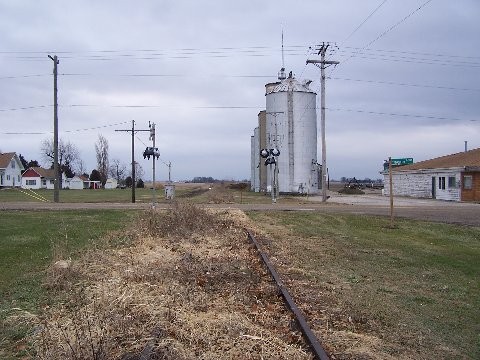
4.) Leave the signals, and install "TRACKS OUT OF SERVICE" or (in the past, I don't think they are used anymore) "ABANDONED" signs below (or in some cases, bolted over the top of) the crossbucks.
5.) Do as above but install "EXEMPT" signs instead. This allows buses and other vehicles (such as trucks carrying hazardous materials) that would normally have to stop and look at the crossing, to be "exempt" from doing so. However this is somewhat ambiguous because the rail line being unused or abandoned is not the only reason (at least per Wisconsin law) that a crossing can be "exempted." The crossing being located close to an intersection where the stopping vehicles would create a significant obstruction to the flow of traffic is another. However, it is common for "EXEMPT" crossings to mostly be on lines with light/slow train traffic. I've never seen one on a busy Class I mainline, for example, but I have seen them at at least one crossing that gets about 6-8 train moves per day.
6.) Remove the signals, but in their place install "TRACKS OUT OF SERVICE" signs on new posts/masts. For example, this was done at WIS-57 in Milwaukee and other crossings on the old Milwaukee Road Beer Line. Note this was done when the tracks were removed everywhere BUT at the crossings. In fact, Google Street view shows that the rails still remained in the road here as of last fall, although the signs had disappeared by 2016!
Another example is the two Webster Avenue crossings in Green Bay that were located on the industrial lead to the Proctor & Gamble East River Mill that came off the old Green Bay & Western line, when it was finally disconnected from the main and formally taken out of service after who knows how many years of not being used.
7.) Do nothing at all and let the signals slowly fall apart over the years, due to weather, vehicle impacts, and sticky-fingered metal scrappers/souvenir-hunting "railfans." This was done on UP's ex-C&NW Capitol Drive industrial lead in Milwaukee, at Hampton Avenue and Lydell Avenue. The last train I believe was in 2003. Buses and other vehicles presumably were still required to stop and check down the rusty, weed-choked, obviously unused tracks. The signals were finally removed by September, 2011, and the tracks by 2015 as the Oak Leaf Trail was being built along the ROW.
Have any of you observed any other methods of indicating an out-of-service crossing to road users?