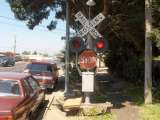
This was the first type of highway crossing light to be invented. This type of light started springing up around the early 1920s, and soon grew in popularity in the mid 1930s.
The 8" is the diameter of the red area (the "lens", also called sometimes "roundel"). Actually, 8" isn't really correct. The actual size is 8 3/8".
The black discs are called "backgrounds" and are 20" in diameter. They're designed to provide a contrast against the light to make it more visible. The "fingernails" above are called "visors", and they are installed to project a shadow on the lens most of the daytime (except in early sunrise or late sunset).
Some railroad signal manufacturers still offer these types of lights for sale. In the United States, 8" lights are typically not used in new signal installations in favor of 12" lights. Any new installation/upgrade that has funding from the federal government must use 12" lights.
The lights are mounted on the mast via brackets and a "crossarm" (the box that can be seen between the lights, which usually says the manufacturer's name). Normally, non-gated systems have the crossarms installed facing front, while gated signals have them installed facing away the street (for the gate to clear the lights).
The first type of 8" lights showed up on a certain signal called "Griswold Rotating Banner". These signals had a stop sign over/under the 8" lights that would rotate to face traffic when the lights would activate. I don't know why these were retired, but I like these. Less than 10 of these signals exist today in the U.S., with the best example being in San Jose, CA.
NOTE: Union Switch & Signal does not make 8" lights anymore. Only 12" with 20" or 24" backgrounds are available from them.
Most 8" lightss have pretty much the same design (although they come in slightly different shapes, depending on the company which manufactured them), but there are some 8" lights which have special designs...
|
Griswold
"A" Lights
LAST UPDATE: |
Griswold "B" Lights
LAST UPDATE: |
G.R.S.
"LEX-C" Lights
LAST UPDATE: |
|
GRS/GRSA
XB & XD Lights
LAST UPDATE: |
Current
8" Lights
LAST UPDATE: |